
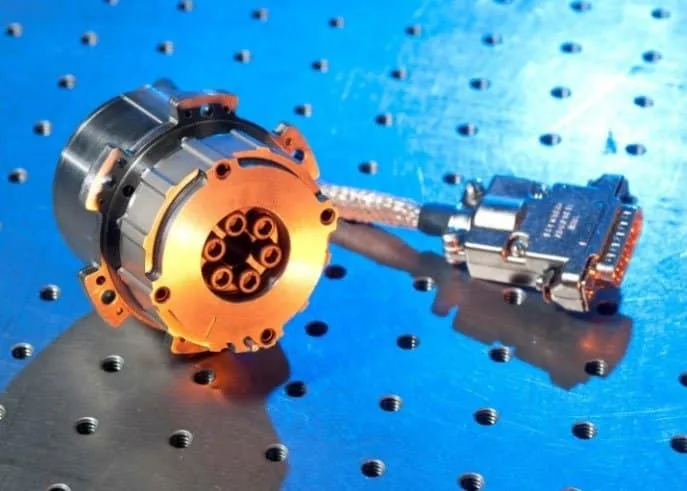
C14 Incremental Rotary Actuator
The C14 originated as an antenna-pointing actuator and was adapted for solar-array drive applications, illustrating how one mechanism architecture can serve distinct integration needs.
Power and Precision Systems
Precision, low-disturbance pointing and motion-control systems for antennas, sensors, optical instruments, solar arrays, and mission payloads.
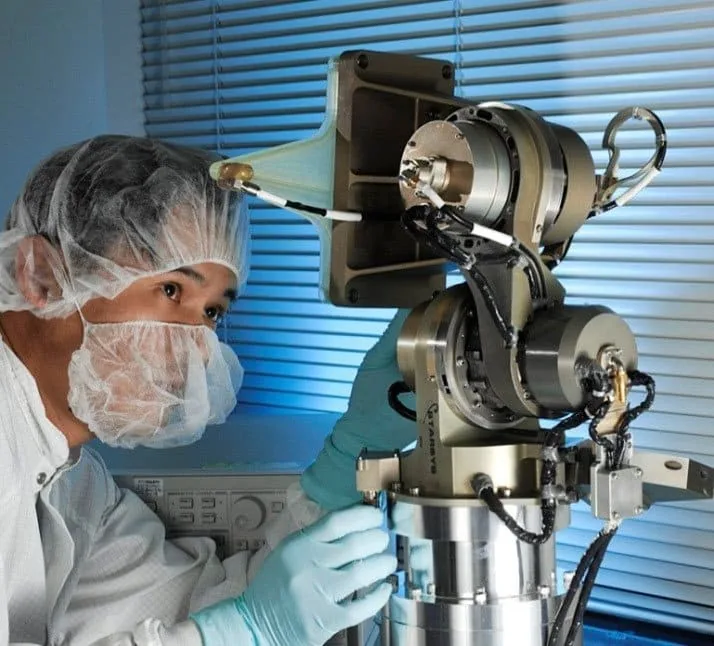
Mission movement
We have developed several single- and dual-axis pointing systems for deploying and positioning antennae, solar array drives and mechanisms, optical telescopes, and instrument mechanisms.
Portfolio scope
Product selection depends on the movement and disturbance profile required by the spacecraft.
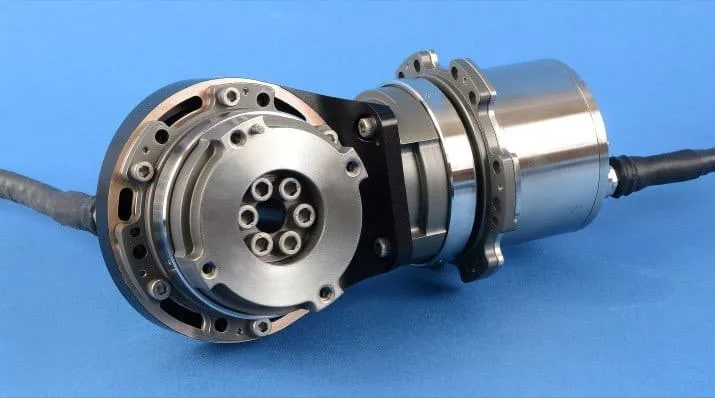
System engineering
Each axis of the pointing system is typically driven by a precision rotary actuator, which features a redundant stepper motor, strain wave gearset and/or hybrid transmission, with various position telemetry options. The rotary actuator is configurable with multiple options, through holes for cable management, slip rings, twist capsules, radio frequency (RF) rotary joints, telemetry sensors and adjustable hard stops. The biaxial brackets have been designed for minimal orthogonal distortion, high stiffness, and low mass.
Published examples
The C14 originated as an antenna-pointing actuator and was adapted for solar-array drive applications, illustrating how one mechanism architecture can serve distinct integration needs.
The C20 incremental rotary actuator is a low-disturbance mechanism used for antenna pointing on the GeoEye-1 Earth-observation spacecraft. LDC20 is a distinct low-disturbance gimbal in the same published portfolio.
Questions