
Insight ·
Sierra Space Advances Thermal Control Technology with Successful TVAC Testing of Deployable Radiator Prototype
Published by Sierra Space
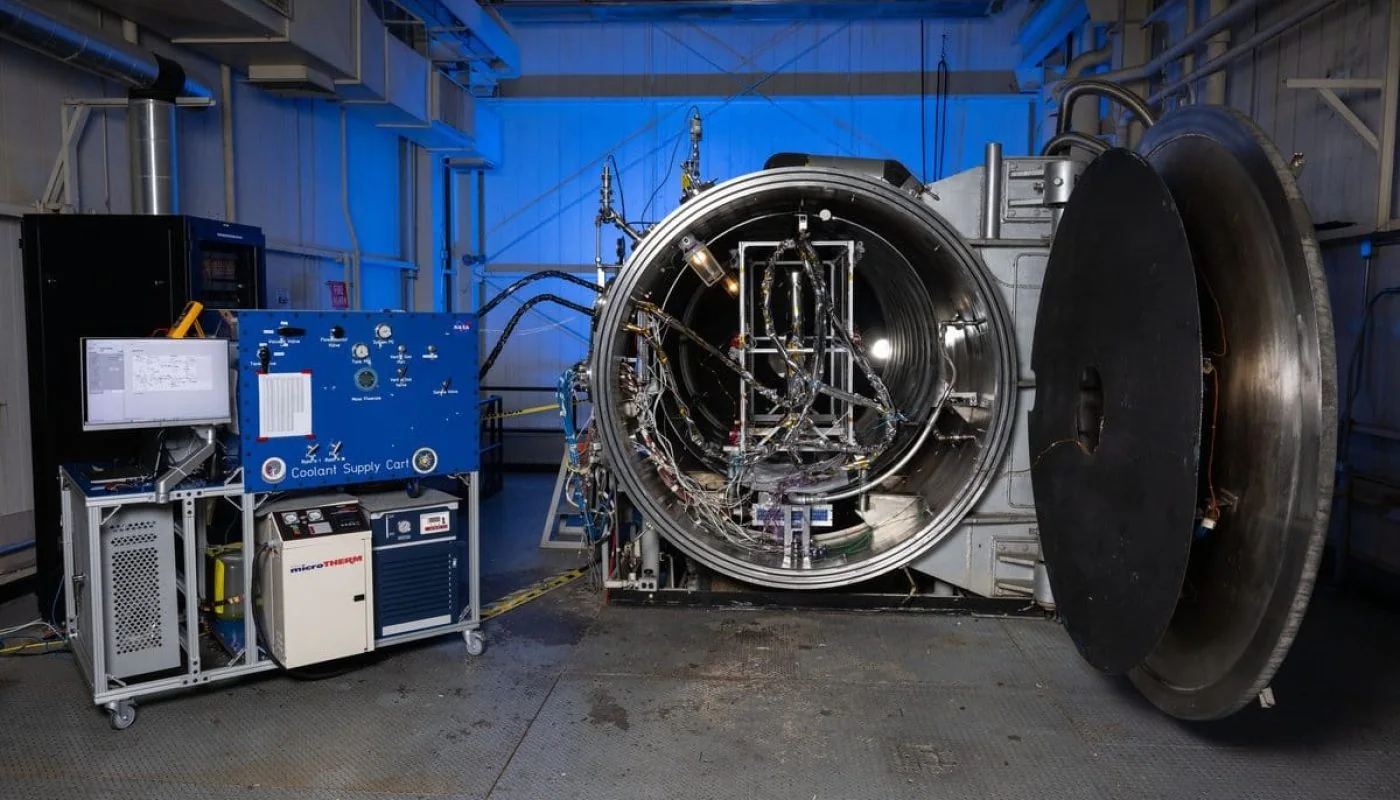
Sierra Space has successfully completed thermal vacuum chamber (TVAC) testing on a deployable radiator panel prototype at NASA's Johnson Space Center, marking a milestone in advancing the company's spacecraft thermal control capabilities.
The test evaluated the radiator's performance under the extreme thermal and vacuum conditions of space and represented another successful collaboration under CCSC-2 (Collaborations for Commercial Space Capabilities 2), Sierra Space's unfunded Space Act Agreement (uSAA) with NASA.
Through this ongoing collaboration, Sierra Space continues to mature in-space technologies that will support future commercial, government, and exploration missions.
Why Radiators Matter
All spacecraft generate heat from electronics, life support, and propulsion systems. Without a way to remove that heat, onboard equipment can fail and crew can overheat.
Radiator systems provide critical heat rejection capability. They allow excess heat generated within the vehicle to be radiated into space.
Large spacecraft often use pumped fluid loops that collect waste heat within the vehicle and transport it to the radiator panels. This ensures efficient, continuous thermal regulation, a requirement for both crewed and uncrewed missions in low Earth orbit and beyond.
TVAC Testing: Purpose, Process, and Outcomes
Thermal Vacuum (TVAC) testing replicates the harsh environmental extremes of space, combining near-vacuum pressure with cycles of high and low temperatures. This process validates a system's performance, durability, and ability to maintain functionality under repeated exposure to these conditions.
For Sierra Space, TVAC testing of the deployable radiator prototype provided critical data and insights, including:
- Validation of mathematical models predicting radiator performance through correlation with real-world measurements.
- Verification of leak integrity across fluid channels.
- Evaluation of flow distribution and overall heat rejection efficiency.
- Observation of component behavior during repeated thermal cycling.
- Risk reduction in manufacturing processes and materials.
- Operational insights gained from test setup and execution.
The prototype performed as expected under simulated orbital conditions, confirming the radiator's design and functionality while reducing potential risks for future deployment.
About the CCSC-2 Collaboration
This work was conducted as part of CCSC-2 (Collaborations for Commercial Space Capabilities 2), Sierra Space's unfunded Space Act Agreement (uSAA) with NASA, executed in June 2023.
The agreement enables collaboration between NASA and Sierra Space to advance technologies related to space destinations, transportation systems, in-space research, and logistics.
Through CCSC-2, Sierra Space leverages NASA's test facilities, expertise, and resources while providing reciprocal insight into our commercial technology development. This testing campaign is one of several milestones completed under the agreement, contributing to a shared goal of maturing commercial in-space infrastructure.
Next Steps
Following successful TVAC testing, Sierra Space engineers are using the data to refine radiator design, improve manufacturing processes, and continue advancing thermal control systems toward flight readiness.
Future development efforts will include:
- Hyper Velocity Impact Testing to assess micrometeoroid and orbital debris (MMOD) protection
- Scalability studies for larger spacecraft applications
Building Reliable Systems for the Future of Spaceflight
Thermal control is fundamental to building the systems that sustain long-duration missions and support a growing commercial presence in orbit.
The successful completion of this TVAC test demonstrates the company's ability to design, build, and validate flight-ready hardware in partnership with NASA and the broader space community.
Sierra Space remains committed to pioneering solutions that make in-space operations safer, more reliable, and more sustainable.
Learn more about Sierra Space hardware development and in-space systems.
Environmental Systems